About
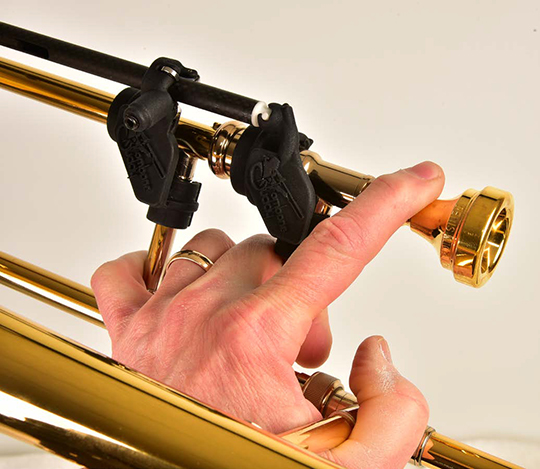
TromboneBuddy™ is a highly developed position trainer that attaches quickly and easily to any small or medium bore trombone. It provides previously unavailable precise tactile position feedback that directly trains muscle memory. It allows learning with eyes closed. This avoids the arduous but inevitable and lengthy task to transfer previously learned visually stored position information to the correct part of the brain where muscle memory is processed and stored. Beginners quickly and precisely learn the position locations with eyes closed, and more advanced players fine tune their accuracy.
Rather than teaching students to locate slide positions visually—a skill they must eventually learn to perform without looking—TromboneBuddy™ uses precise tactile feedback to develop proprioception and motor memory from the outset, eliminating an unnecessary intermediate learning step.
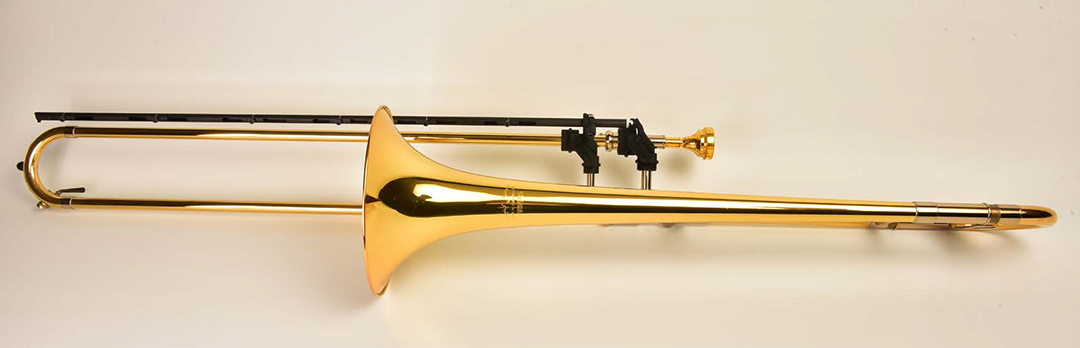
TromboneBuddy™ is the result of 3 generations and over 100 years of music experience playing and teaching the trombone. Designed and developed by Randy Stroetz, whose experience playing trombone over 50 years, and “day job” of 30 plus years as biomedical engineer and researcher, has resulted in a training device that is both elegant and highly functional.
Features:
- Made with ultra light carbon fiber, very tough and most players can’t feel a difference in slide movement when TromboneBuddy™ is attached.
- Attaches and detaches in seconds with non-marring clips, making TromboneBuddy™ easy and quick to use, stores in case.
- SlideSaver, a safety stop, is included so new students aren’t likely to drop & damage the delicate outer slide.
- Each position marker can be individually adjusted to accommodate fine tuning of any trombone.
- Provides an accurate and obvious visual reference to each position that is easy to see while playing.
- The magnetic version adds a tactile “notch” feeling to each position to accentuate neuromechanical sensations as the player’s arm is extended and retracted while playing. This is commonly referred to as “muscle memory.” Since this position feedback is mechanical and non-visual, it uses a different, less overloaded neurosensory path, and students can learn to play with precise position movements much more quickly than with traditional learning methods.